
Executive summary — As global tax authorities transition from periodic, retrospective tax auditing to real-time Continuous Transaction Controls (CTC), the primary challenge for multinational enterprises is no longer technical document transmission — it is semantic convergence. By standardising transaction data models across diverse jurisdictions including the UK, the UAE, Oman, and Belgium, organisations can eliminate fragmented, country-specific ERP configurations, strengthen master-data governance, and establish a globally scalable, reusable transaction architecture.
1. The global paradigm shift: beyond transmission to shared meaning
The global indirect tax landscape is undergoing a structural realignment. For decades, multinational corporations managed VAT and GST compliance through localised, post-event reporting. Enterprise Resource Planning (ERP) systems recorded commercial activity, month-end routines aggregated ledger entries, and tax teams manually compiled and reconciled static tax returns long after commercial events had closed.
Today, tax administrations across Europe, the Middle East, and Asia-Pacific are dismantling this retrospective model. In its place, governments are mandating real-time invoice validation, structured e-invoicing, and continuous network reporting.
When evaluating these global mandates, enterprise technology leaders often make a fundamental strategic error: treating e-invoicing as a document transmission project.
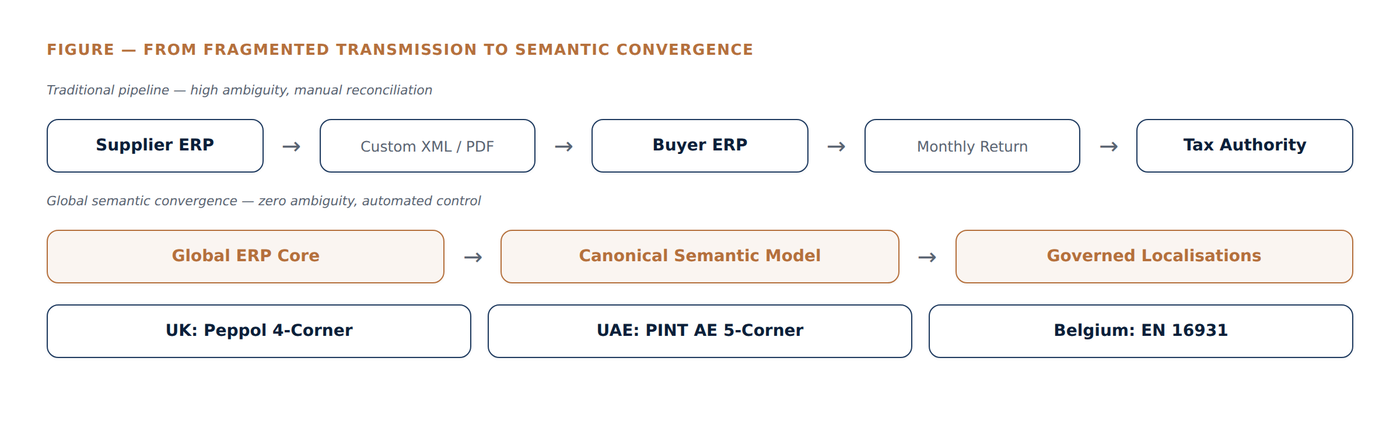
Moving a digital payload electronically between two endpoints is a solved technical problem. The true architectural challenge lies in semantic convergence: ensuring that the supplier, customer, intermediary network, service provider, auditor, and tax administration interpret every data element within that transaction in exactly the same way.
- Technical connectivity ensures a file travels successfully from Point A to Point B.
- Semantic convergence preserves the exact commercial, legal, and tax meaning of the transaction payload as it moves through diverse accounting engines, middleware, and network nodes.
Without semantic convergence, digital connectivity simply accelerates structured ambiguity. With it, enterprises can build a single, globally reusable transaction architecture across all operational footprint markets.
2. Decoupling core transaction semantics from national tax law
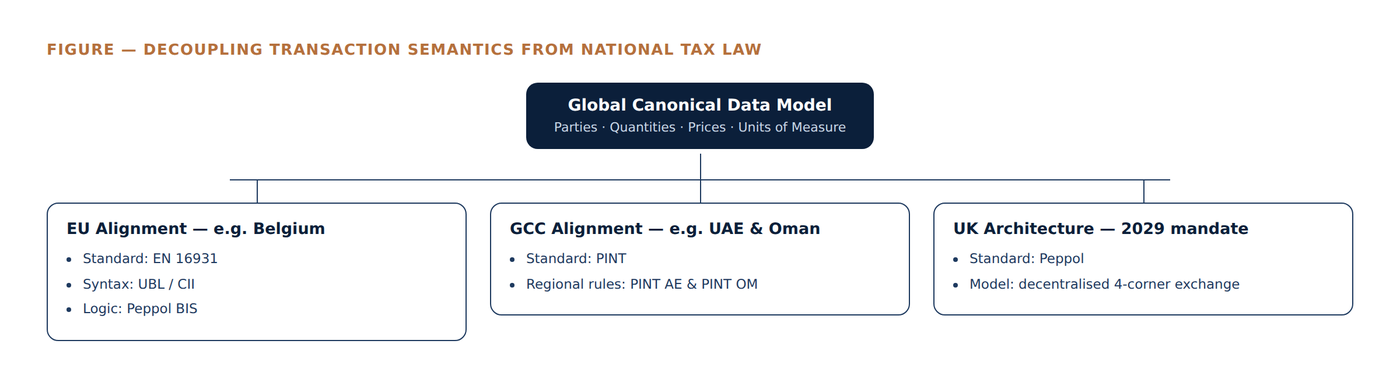
The architectural power of modern interoperability frameworks — specifically Peppol and its underlying Peppol International Invoice (PINT) methodology — is that they decouple commercial transaction logic from national tax rules.
Historically, every time a country introduced a new tax reporting requirement, enterprise IT departments responded by customising the core ERP template — adding bespoke customer fields, custom tax determination scripts, localised invoice print layouts, and manual spreadsheet workarounds. Over time, this created fragile, heavily customised ERP environments that were exceptionally costly to upgrade and maintain.
Semantic frameworks alter this equation by establishing a multi-layered design hierarchy.
Layer 1: the common semantic layer
Universally recognised business concepts remain consistent across all jurisdictions. Attributes such as seller and buyer identities, invoice numbers, line item descriptions, net unit prices, quantities, standard units of measure, and document totals follow a single global definition.
Layer 2: the governed jurisdictional extension
Country-specific tax requirements — such as local tax registration formats (e.g. TRNs/TINs), specific exemption reason codes, dual-currency reporting rules, or local document type classifications — are isolated into a controlled localisation layer.
Layer 3: the enterprise operational core
The enterprise builds its internal Order-to-Cash (O2C) and Procure-to-Pay (P2P) workflows around the common semantic layer, treating jurisdictional rules as governed extensions rather than foundational code changes.
Enterprise design principle — standardise the global transaction architecture. Govern jurisdiction-specific legal deviations through modular, controlled localisations.
3. Four jurisdictional archetypes: UK, UAE, Oman, and Belgium
To understand how semantic convergence operates in practice, consider how four key jurisdictions are implementing structured e-invoicing using shared standards.
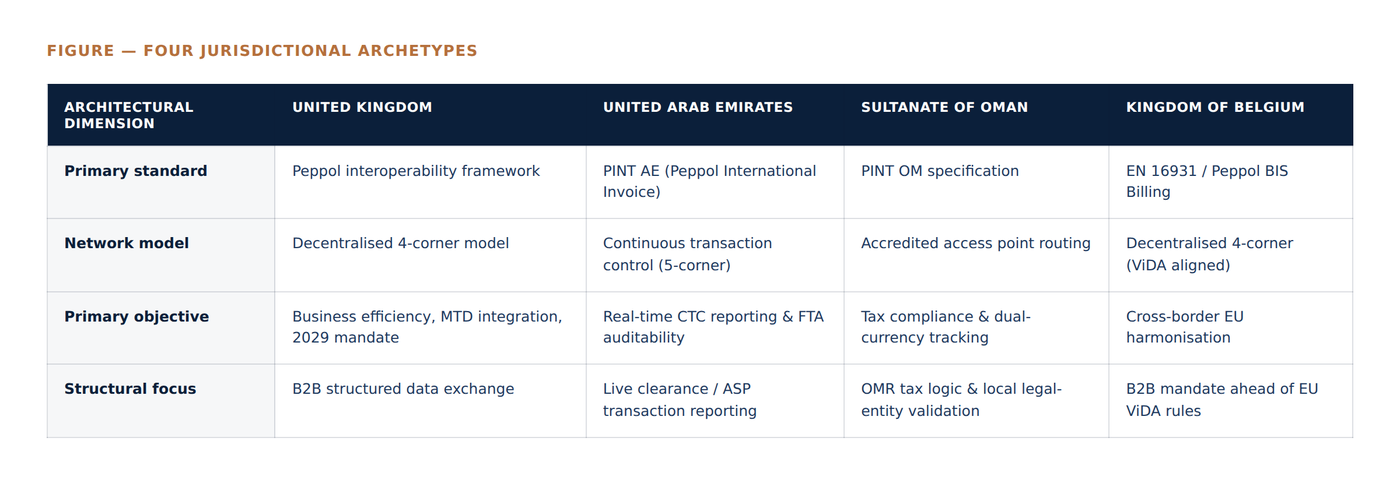
United Kingdom: decentralised 4-corner interoperability
The UK's strategy ahead of its planned 2029 mandatory VAT e-invoicing regime focuses on leveraging the established Peppol decentralised 4-corner network. By selecting an open, interoperable network over a centralised government clearance portal (such as Italy's SDI), the UK enables buyers and sellers to exchange structured UBL/XML documents seamlessly through their choice of accredited service providers (access points). This "connect once, reach all" framework avoids creating isolated government databases and preserves direct machine-to-machine efficiency.
United Arab Emirates: the PINT AE 5-corner CTC framework
The UAE's Federal Tax Authority (FTA) has developed PINT AE, adapting the international PINT specification to local VAT legislation. The UAE utilises a 5-corner model: B2B invoices are exchanged directly across the Peppol network between the seller's and buyer's Accredited Service Providers (ASPs), while transaction data is simultaneously transmitted in real time to the tax authority for continuous compliance monitoring.
Sultanate of Oman: PINT OM and dual-currency governance
Oman's e-invoicing architecture utilises the PINT OM specification. PINT OM demonstrates how the PINT methodology accommodates non-European tax mechanisms, such as mandatory dual-currency calculations (converting foreign contract values into Omani Rials at official central bank rates) and strict validation of local tax registration numbers (TINs) at the network border.
Kingdom of Belgium: EN 16931 and European Union ViDA alignment
Belgium's mandatory B2B e-invoicing regime operates through EN 16931 (the European Standard for electronic invoicing) and Peppol BIS Billing. As an EU member state, Belgium's implementation serves as an operational blueprint for the broader VAT in the Digital Age (ViDA) directive, demonstrating how standardised European semantics enable seamless cross-border automated processing.
4. Master data as an external tax control
In traditional paper, image-based, or PDF invoicing, master-data errors were usually mitigated downstream through human intervention. An incorrect postal code, a minor discrepancy in a legal name, or an unmapped unit of measure was routinely corrected by accounts payable staff or caught during manual month-end reconciliations.
In a real-time, semantically enforced e-invoicing environment, master-data errors result in immediate, automated network rejections.
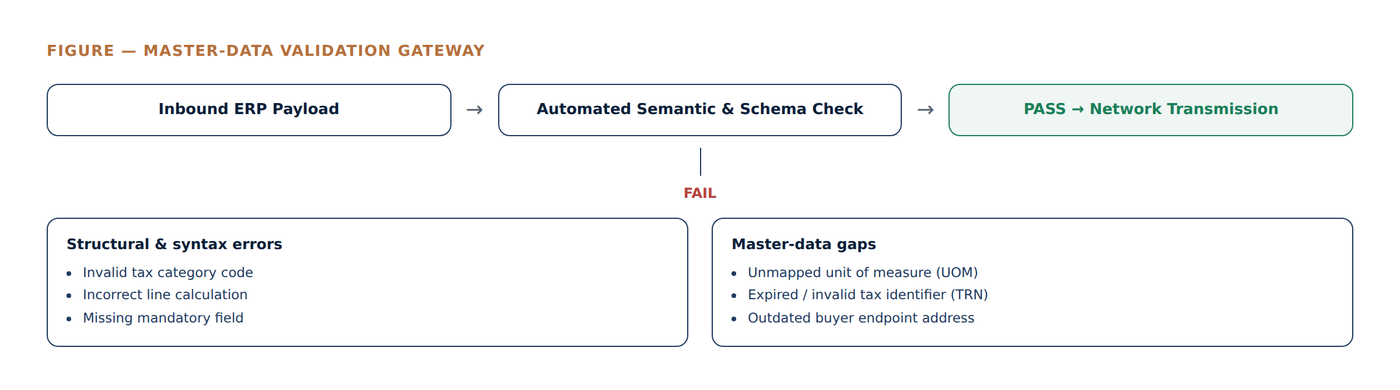
Because Peppol access points and tax authority validation engines execute strict automated checks before accepting an invoice, master-data governance moves from a passive back-office IT task into the external tax control framework.
Critical master-data vectors requiring enterprise governance
- Party identifiers and addresses. Validated tax registration numbers (TRNs/TINs) against government databases; registered Peppol endpoint IDs (e.g. GLN, UK Companies House numbers, UAE TRNs); ISO country codes and structured postal address elements.
- Product and service classifications. Standardised UNSPSC or HS code mappings where required by national law; harmonised units of measure mapped strictly to UNECE Rec 20/21 standards.
- Tax determination and code lists. Alignment of internal ERP tax codes with Peppol/PINT tax categories (S = standard rate, Z = zero rated, E = exempt, AE = reverse charge); documented mapping of legal exemption reasons to mandated network code lists.
5. Connecting enterprise architecture with Tax Administration 3.0
The OECD's Tax Administration 3.0 blueprint outlines a vision where tax compliance is no longer a periodic, secondary process performed after transactions occur. Instead, tax controls are embedded directly into the natural operational systems used by businesses to conduct trade.
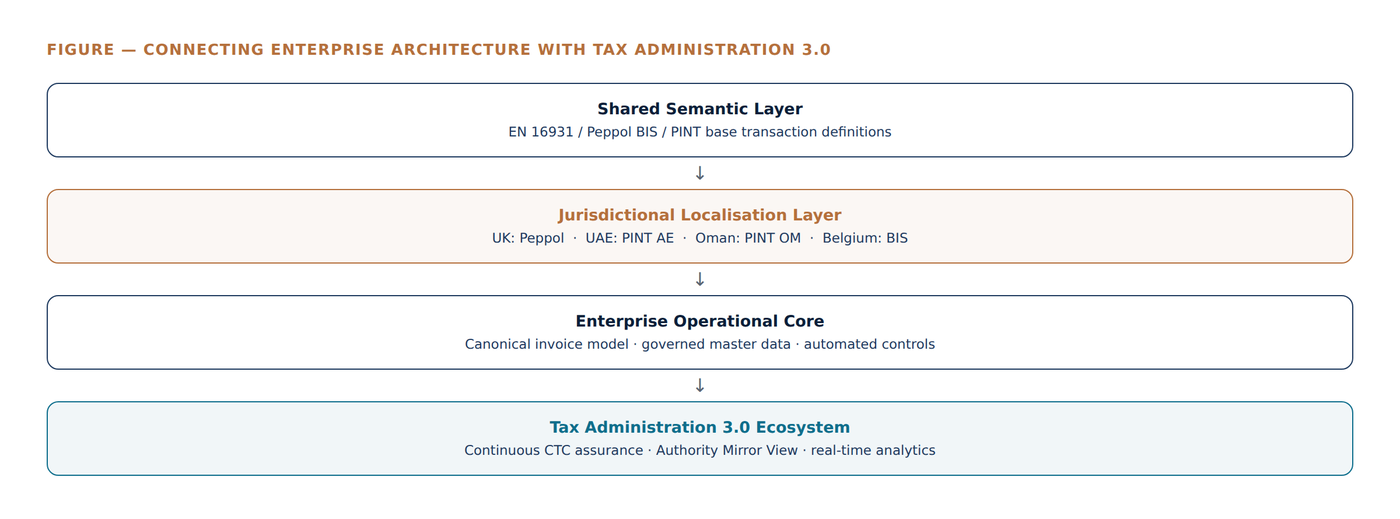
Semantic convergence provides the foundational connective tissue that enables Tax Administration 3.0 to function across global supply chains. When enterprises standardise their underlying transaction data structures, they effectively bridge three critical operational friction points.
The Tax Velocity Gap™
The operational disconnect between the high speed at which tax authorities receive and validate transaction data externally, and the slower, batch-based speed at which an enterprise reconciles and governs that same data internally. Automated semantic validation closes this gap by verifying data integrity before transmission.
The Authority Mirror View™
The comprehensive digital twin of an enterprise's commercial activity reconstructed by tax authorities using live e-invoicing streams, network receipts, and digital reporting. Standardised semantics ensure that the tax authority's digital view matches the enterprise's internal general ledger.
Interpretive Divergence™
The risk that the buyer, seller, service provider, and tax authority apply conflicting legal or accounting interpretations to the same commercial transaction. Shared definitions establish a single reference point for the transaction facts, isolating legal disagreements from data structure errors.
Operational insight — "Received ≠ accepted ≠ posted ≠ claimed ≠ defended." A successful network transmission confirmation merely proves file delivery. Full tax defensibility requires continuous alignment between network transmission statuses, ERP posting entries, VAT returns, and retained audit evidence.
6. Enterprise execution blueprint: 10 actionable steps
To transition from fragmented country compliance to a unified global transaction architecture, enterprise finance, tax, and IT leaders should execute a structured 10-step roadmap.
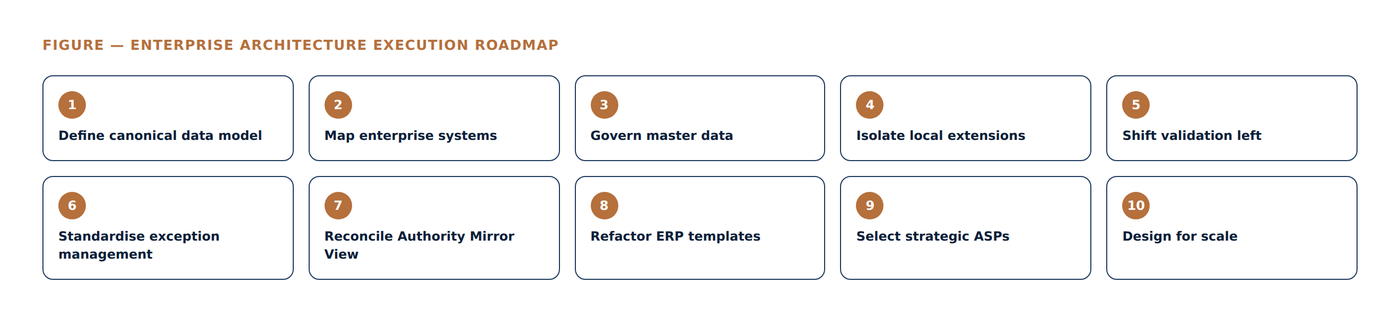
- Define a global canonical data model. Establish a core internal invoice schema based on the international Peppol/PINT standard. Map standard ERP output fields once to this master schema.
- Map system lineage across platforms. Trace invoice data flows across all upstream generation engines — including SAP, Oracle, Microsoft Dynamics, specialised billing engines, CRM platforms, and legacy systems.
- Establish functional master-data ownership. Assign explicit accountability to tax, procurement, sales, and supply chain teams for maintaining tax-critical master data attributes (TRNs, UOMs, addresses).
- Build a governed localisation layer. Isolate regional tax nuances (such as UK VAT rules, UAE PINT AE requirements, or Oman dual-currency rules) into external middleware or rule engines rather than altering core ERP software.
- Shift validation "to the left." Execute structural, semantic, and tax code checks inside the enterprise system before the invoice is issued, preventing network transmission failures.
- Standardise exception management workflows. Create automated workflows to handle invoice rejections, network timeouts, and customer disputes using standard error categories across all operational regions.
- Automate Authority Mirror View™ reconciliation. Build continuous reconciliation routines that match internal ERP general ledger postings with external network transmission logs and tax authority receipts.
- Refactor the global ERP core template. Incorporate e-invoicing semantics directly into the global ERP design template rather than treating each new mandate as a temporary side-car interface.
- Evaluate access points as strategic governance partners. Assess Peppol access points and service providers on their multi-jurisdictional reach, PINT support, schema validation engines, and audit trail retention — not just bandwidth or price per invoice.
- Design for scalable multi-jurisdictional expansion. Build the transaction architecture under the assumption that every operating market will eventually mandate continuous, semantically aligned e-invoicing.
Strategic conclusion
The accelerating global adoption of Peppol across the UK, Europe, the GCC, and Asia-Pacific marks a permanent shift in how commercial transactions are governed.
While individual country mandates create immediate compliance deadlines, viewing e-invoicing purely through a regulatory lens leads to fragmented systems, high maintenance costs, and elevated tax risk.
By leveraging semantic convergence, forward-thinking enterprises can transform compliance obligations into a strategic technology advantage: building a standardised, reusable, and continuous transaction architecture that powers global trade across all jurisdictions.